
The Last Vein Cut
Start at a wide wall
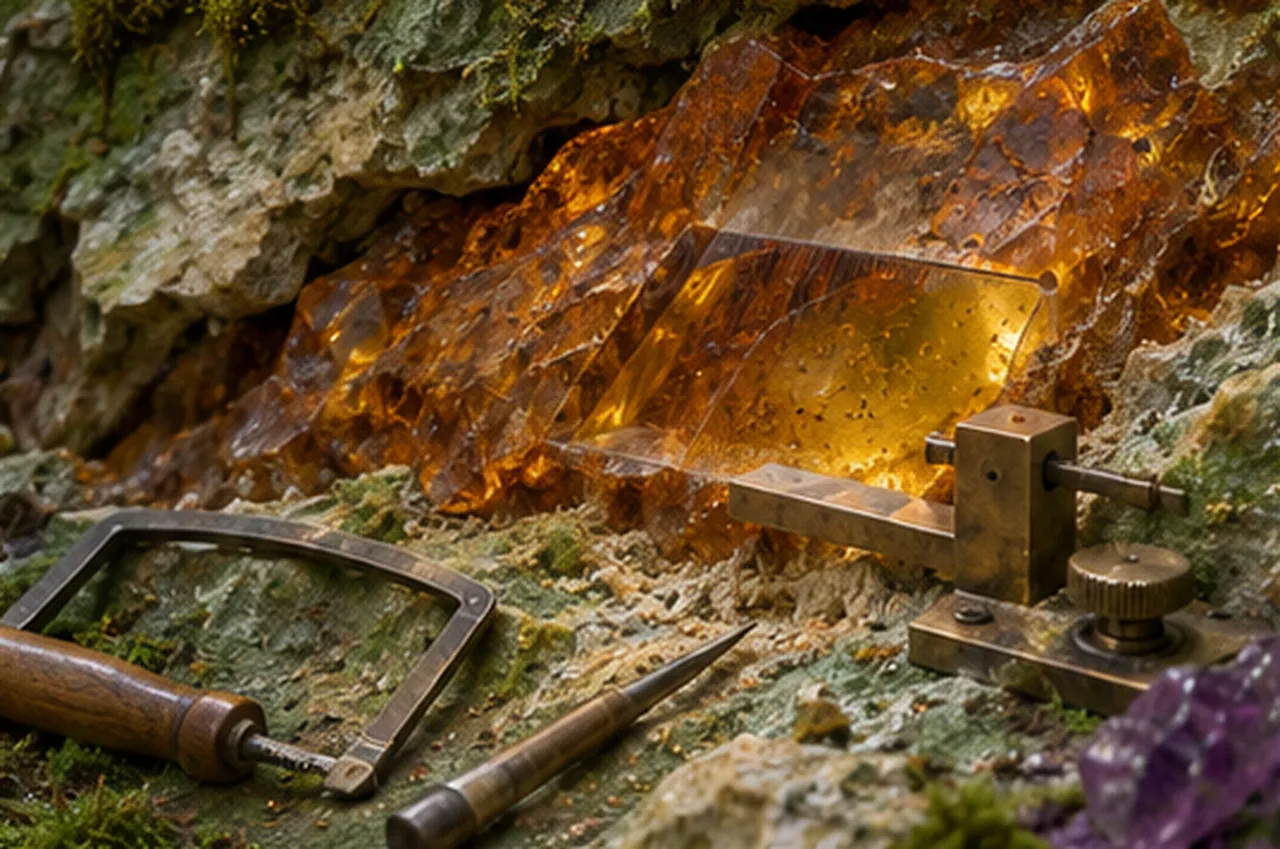
The wall under the old quarry track holds a long band of amber. In the prototype you can walk around the visible edge before touching the saw. On this side the amber rests in shallow grooves. The surface at the far end drops out of view. A brace can hold the piece nearby, but placing it there changes which opening will remain clear when you move down the wall.
Decide where the cut will lead
The selected route stays in view as you shift the camera to the tool’s side. Its beginning is obvious, where the block stands proud of the stone. Midway through the section, one edge narrows to a low amber bridge. You can aim for that bridge or leave it attached while setting a second resting surface. Take another look from the entrance before deciding. The narrowest part on the close view can hide a bend beyond it.
Read movement under the supported side
Pulling the tool away halfway through lets you observe the block against the brace. There is room between two small marks while the center of the block rests. As the kerf approaches the edge, the upper mark moves away from its earlier position. A Range of Pressure describes the padded response that makes that movement visible. The player can pause here and look across the cut without losing the last position.
The last inch
A hollow near the far edge gives you another sightline. In early scenes the forward edge and the hollow become visible in succession. Later scenes make them visible together so that the decision comes from comparing the two. If the brace moves first, you have time to return to the wider angle and change it. When the hollow opens first, a brief still moment lets you set the tool down before lifting anything.
Leave the wall legible
After the block moves, walk back toward the start. Part of the original wall remains behind the cut and the carved line continues across it. It is possible to finish with a slice of resin still attached there. That remnant can show where the block was once held. The End of the Saw Kerf describes the pictures we use to compare different exits. Each makes the direction of movement visible in a different way.
The sound and shape of the scene
The tool has a small dry noise that sits below other sounds of the quarry. A short movement of its handle is visible even when the edge is hidden. The stone dust is pale and soft compared with the bright line around fresh amber. Dark moss helps place the lower gap, whose shape would be hard to read against a uniformly bright background. The player needs to be able to follow the line with the audio muted.
Current questions
The project is at prototype stage. The first test is whether someone can plan a route using the broad view and still recognize the points along it at the tool. A second test is whether either side of the cut can supply enough evidence when one angle is blocked. The larger rooms may carry a series of connected veins eventually. The present version concentrates on the decisions at one wall and the interval between a supported block and a piece ready to leave.